31 Aug 10

The team is proud to announce the release of JBehave 3.0. Download it here.

New features of 3.0 include:

  • Story-centric terminology
  • User stories can be specified as classpath resources or external URL-based resources (local or remote)
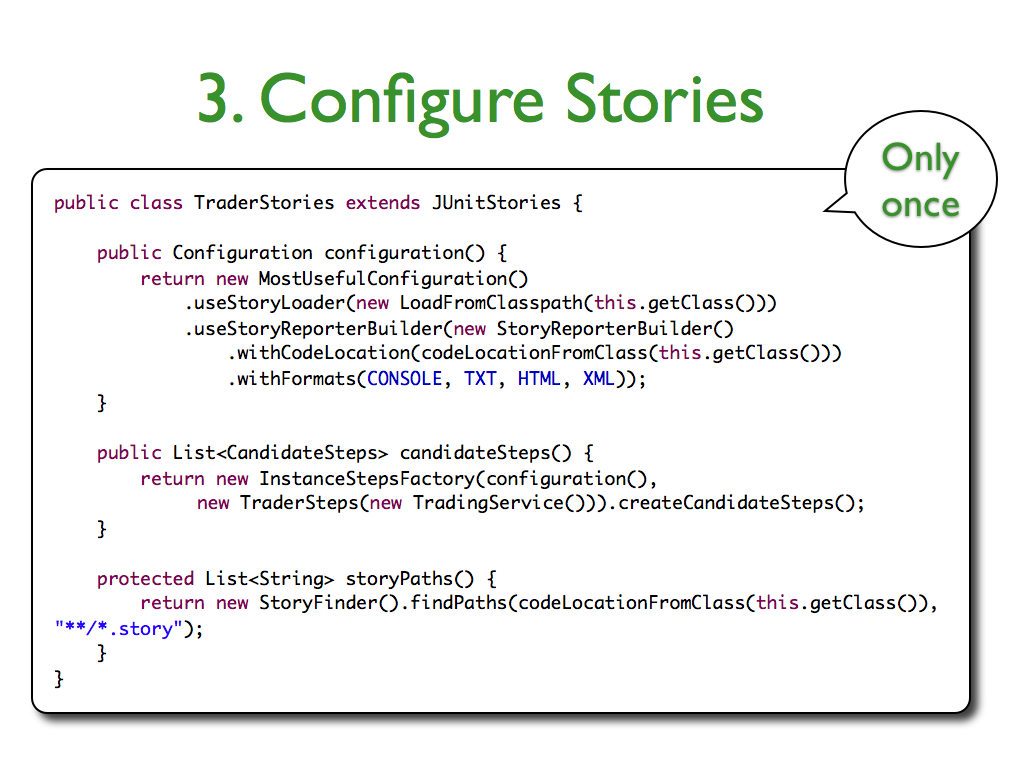
  • Multiple textual stories can be run using a single Java entry point
  • StepFinder allows quick searching of Stepdocs for a given textual step
  • Embedder framework allows running of stories to be embeddable in multiple execution environments
  • Better integration with your favourite IDE: stories can be run as JUnit tests or other annotation-based unit test frameworks
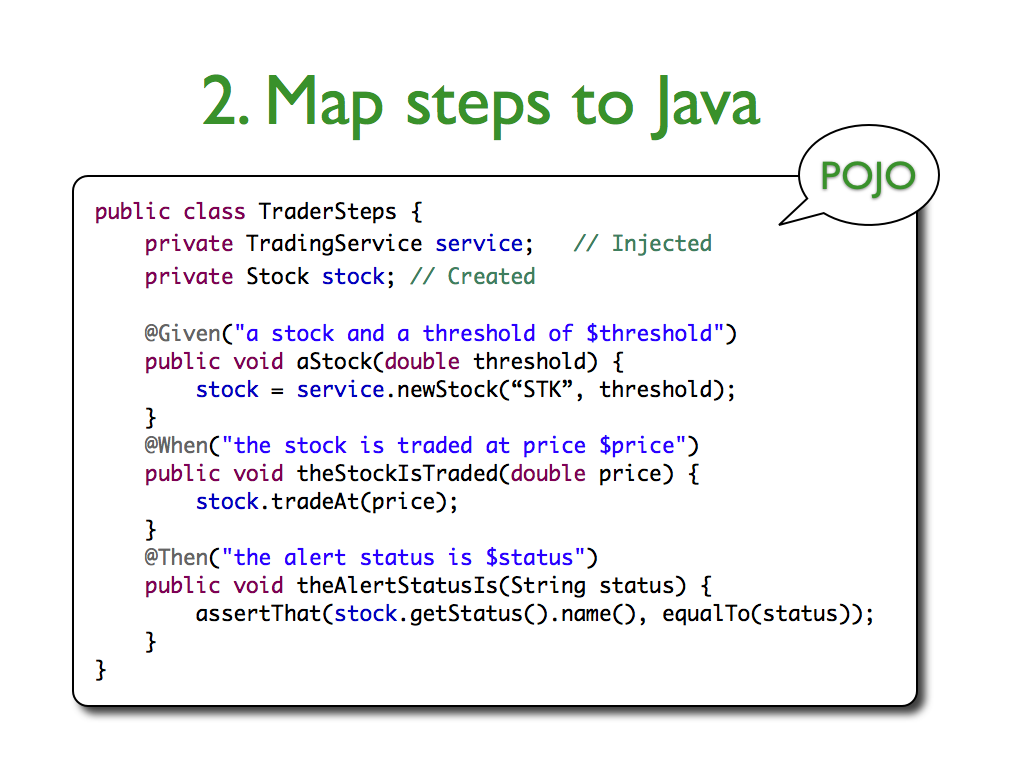
  • Annotation-based configuration and specification of steps instances
  • Dependency Injection support for composition of both configuration and steps instances via your favourite container (Guice, PicoContainer, Spring)
  • Pluggable step prioritising strategy. Strategies provided include: by priority field and by Levenshtein Distance

    A number of smaller improvements and some bug fixes are also included.

    Full release notes (which includes all bug fixes since 2.5.0) can be found in JIRA

    A migration guide can help users migrate from 2.x.

    We hope you continue to enjoy JBehave and always welcome your feedback.


9 Mar 10

The team is proud to announce the release of JBehave 2.5. Download it here.

New features of 2.5 include:

  • Steps dependencies composable via IoC containers (PicoContainer, Spring, Guice)
  • Comments supported between steps in plain-text scenarios
  • Narrative elements added to Story parsing
  • New @BeforeStory and @AfterStory method annotations

    Other smaller improvements and some bug fixes are also included.

    Full release notes can be found in JIRA

    We hope you continue to enjoy JBehave and always welcome your feedback.


20 Jan 10

The team is proud to announce the release of JBehave 2.4. Download it here.

New features of 2.4 include:

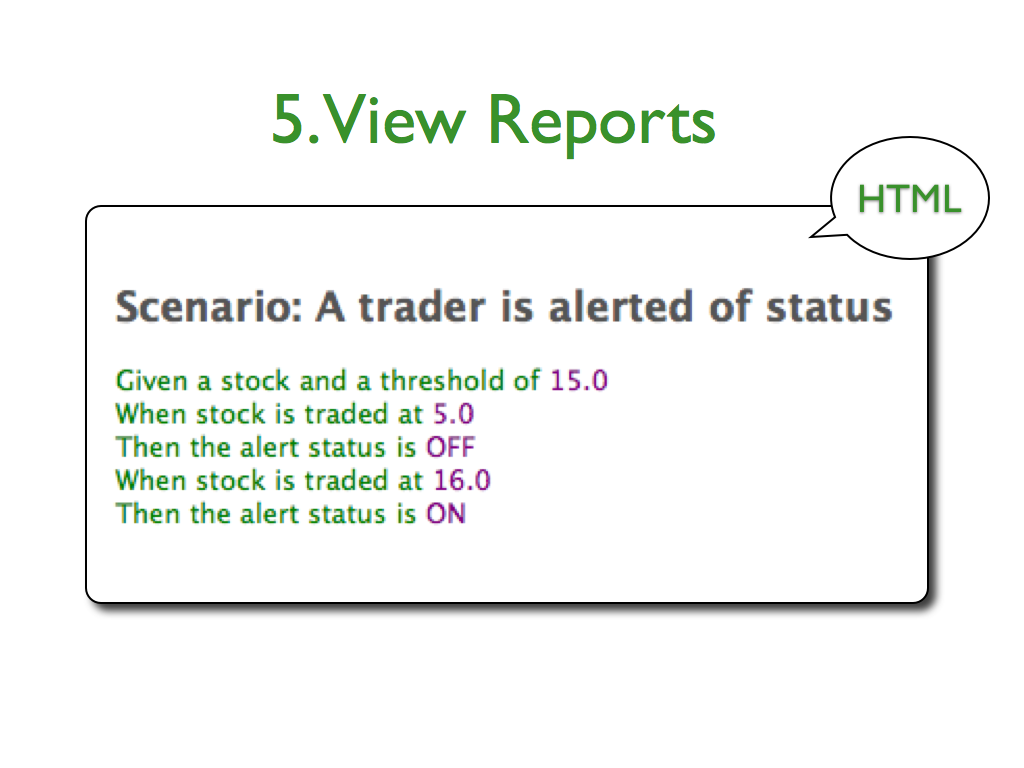
  • Extensible file-based scenario reporting framework in different formats (txt, html, xml)
  • Statistics collection and rendering of number of scenarios run, with successful, failed and pending steps.
  • Candidate steps classes can now be also defined as POJOs, without extending Steps

    Many smaller improvements and some bug fixes are also included.

    Full release notes can be found in JIRA

    We hope you continue to enjoy JBehave and always welcome your feedback.


24 Oct 09

We’ll be presenting a year-long retrospective on using BDD and JBehave in a commercial enterprise in the two upcoming talks:

Paris, 12 Nov 2009

London, 14 Dec 2009

Everybody’s welcome to attend. Both events are free, but may require registration.


11 Oct 09

The team is proud to announce the release of JBehave Web 2.1. Download it here.

Main features of Web 2.1 include:

  • ResourceFinder
  • Allow browsing content of uploaded archive

    Full release notes can be found in JIRA

    We hope you continue to enjoy JBehave and always welcome your feedback.


10 Oct 09

The team is proud to announce the release of JBehave 2.3. Download it here.

New features of 2.3 include:

  • New keyword GivenScenarios allows entire scenarios to be used as pre-conditions
  • New keyword Examples adds tabular support to scenarios
  • Support for named parameters in Steps methods via annotations or Paranamer
  • I18n Keywords

    Full release notes can be found in JIRA

    We hope you continue to enjoy JBehave and always welcome your feedback.


20 Aug 09

The team is proud to announce the release of JBehave Web 2.0. Download it here.

Main features of Web 2.0 include:

  • Web Runner webapp that allows any scenario to be run via a simple web interface. More info
  • Web view of Stepdoc generated for the Steps used in the scenarios
  • Selenium support to help running web-based scenarios. More info

    We hope you continue to enjoy JBehave and always welcome your feedback.


24 Apr 09

The team is proud to announce the release of JBehave 2.2. Download it here.

New features of 2.2 include:

  • New annotation @Aliases to define multiple aliases for steps
  • Stepdoc generator to list the annotated candidate steps available to scenario writers, with step patterns and aliases
  • Improved rendering of step failures
  • Improved parsing of scenarios

    Full list of issues can be found in JIRA

    We hope you continue to enjoy JBehave and always welcome your feedback.


25 Oct 08

The team is proud to announce the release of JBehave 2.1. Download it here.

New features of 2.1 include

  • New annotations @BeforeScenario and @AfterScenario to reset the state after each scenario in a multi-scenario story
  • Pluggable support for different unit-level frameworks (we recommend the latest JUnit)
  • Support for both JUnit 4 and JUnit 3
  • Ant task to run scenarios
  • Some usability improvements for scenario developers

    We hope you continue to enjoy JBehave2 and always welcome your feedback.


3 Sep 08

The team is proud to announce the release of our second version. Download it here.

JBehave is a Java-based framework designed to encourage collaboration between Developers, QAs, BAs, business stakeholders and any other team members through automated but human-readable scenarios. Its features include:

  • Plain text scenarios
  • Support for multiple scenarios in a file
  • Pending scenarios (the “Amber Bar”)
  • Clear, easy-to-read output from failures and pending scenarios
  • Parameter capture from scenarios
  • Conversion of parameters to your own objects
  • Support for multiple languages and scenario terminology
  • A high degree of configurability
  • Maven support

    Compare to 1.x releases, in JBehave 2.x we no longer provide

  • mocking frameworks (we recommend Mockito)
  • unit-level frameworks (we recommend the latest JUnit)
  • IDE plugins (JBehave 2.x uses JUnit to run scenarios as tests in IDEs)
  • Swing support (moved to Tyburn)

    We hope you enjoy using JBehave 2 and welcome your feedback.